Related tags
Conditional pricing that builds itself and checks its own logic
Drop 7 of Two Minute Tuesdays — a weekly series from Nue about agentic revenue architecture. Every Tuesday at 8 AM PT.
Conditional percent-of-total sounds like jargon. The logic behind it is plain: one line's price should track another line, and the rate should flex with volume.
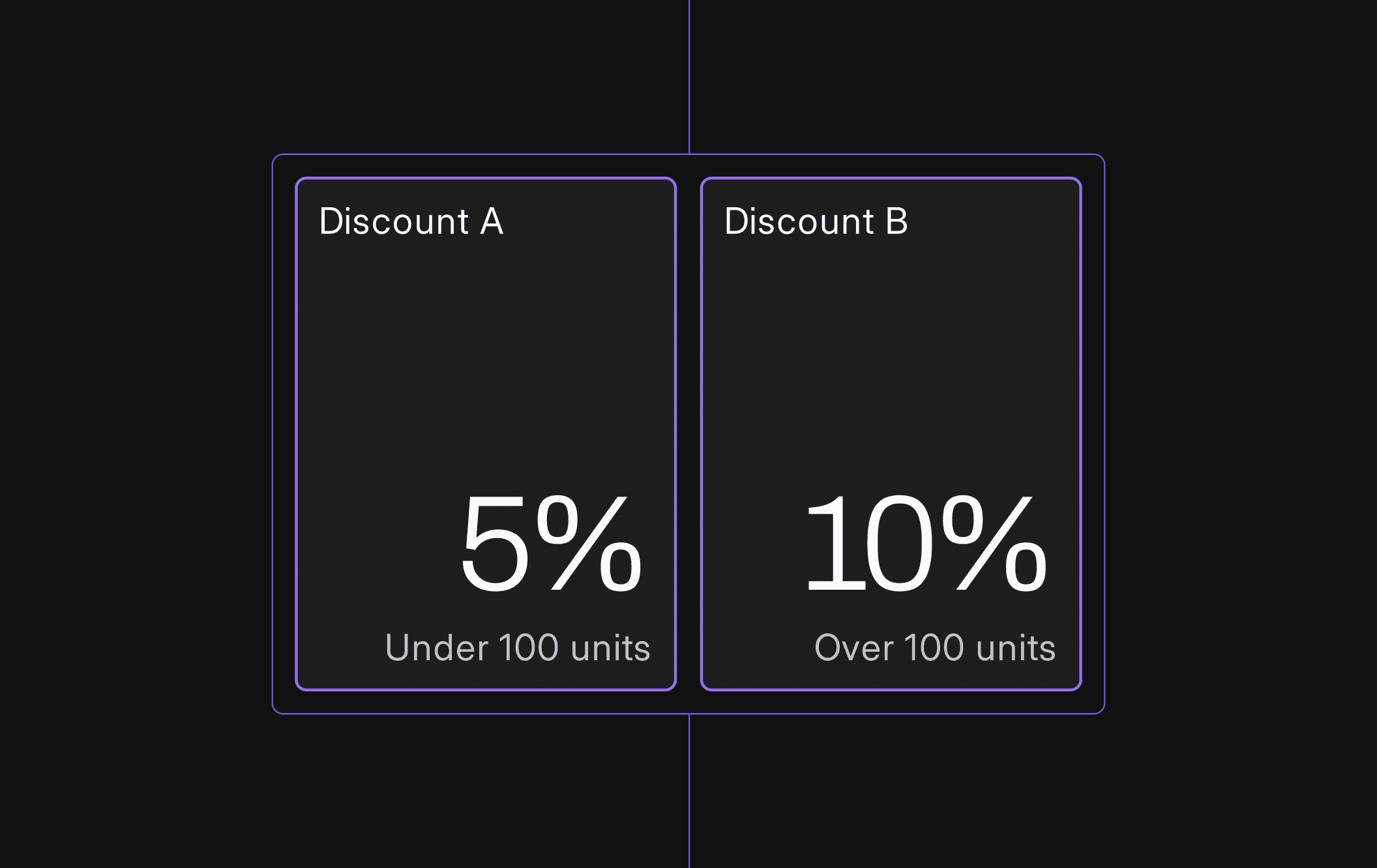
The version that comes up most often looks like this. A support or services line is priced as a percentage of the product it attaches to, and that percentage steps down as quantity climbs, because the economics change at scale. Every pricing team has a version of this rule. Most CPQs can't model it directly, so teams reach for relationship workarounds or rebuild the math by hand.
In this week's demo, the rule gets built in Price Builder AI. The rep describes it in plain English: price the support SKU at 10% of the paired product line when that product's quantity is under 100, and at 5% when it goes over 100.
Nue's Price Builder AI lays out the steps it will take, finds the line, checks the quantity, and updates the price. After a couple of debugging passes, the plugin is working in about five minutes.
Then the rep tests it inline. Set the paired quantity to 200 and the support price recalculates against the new total. Drop it to 100 and the rate steps to 5%. Push it under the threshold and it returns to 10%. The math updates in the quote as the inputs change, with no separate validation step.
Speed only matters if the rule stays trustworthy after it ships, and that's the other half of this story. A percentage-of-total relationship can go wrong in ways that have nothing to do with how it was built: two products end up priced as a percentage of each other, creating a loop with no stable answer; a product gets set as both the base and the target of its own rule; or a relationship quietly goes stale after someone upgrades, downgrades, or swaps out the product it points to. None of that is specific to AI-built plugins. A manually configured percent-of-total relationship in Price Builder can drift into the same states, usually discovered when a quote comes back wrong.
The point is who can reach this kind of logic now, and what happens after they do. A rule that has to read one line off another, and shift its rate by volume, is exactly the kind of logic that used to land in an engineering queue. Here it's built and tested by the person who owns the pricing, in the time it takes to describe it, and it stays governed after it ships, not just fast to stand up.
Every Tuesday, we'll send you a two-minute walkthrough of one benefit of revenue architecture in practice — not a vision deck, not a slide, just a product doing the work.