Beyond Zero-Code: How Nue Price Builder Plugins Deliver Infinite Last-Mile Pricing
Related tags
Beyond Zero-Code: How Nue Price Builder Plugins Deliver Infinite Last-Mile Pricing

Saurabh Radhakrishnan, VP of Product
The biggest deal of the quarter is one signature away, but the customer wants Professional Services priced at a fixed percentage of two specific line items only, nothing else on the deal counts. There's also a hard dollar floor if that math comes out low, and it has to hold automatically on every renewal and change order from here on.
As RevOps, you own pricing implementation, so it lands on you.
Your CPQ can't express it, Sales needs the quote today, and engineering's next sprint is two weeks out. So you do what RevOps admins always do: hand-build a workaround, unblock the rep, and hope the renewal math still holds eighteen months from now.
Every RevOps leader knows this moment. It is not the 80% of pricing that fits a template. It’s the last 20%: the negotiated rate, the quantity-by-term grid, the ramp that must land on a fiscal boundary. That last mile is where deals are won and margins are protected, and where every pricing platform quietly breaks.
The industry's answer for a decade was "no code," but the real problem was never code. It was that the last mile stayed locked away from the people who own pricing. Nue's Price Builder plugins change that: zero-code is table stakes; making last-mile customization self-service is the breakthrough.
Configuration handles common cases well, then fails the moment you need something the rule builder did not anticipate. Now you face three bad options: an engineering ticket that takes weeks, a brittle validation rule, or a data workaround that corrupts your renewals later. What should take minutes takes two to three weeks, because every real exception routes through a developer.
The irony is that configuration was supposed to prevent this. Our CTO and co-founder Tina Kung watched it play out in legacy CPQ: point-and-click rules meant to scale instead piled into libraries of 50 to 100 rules, triggering each other in sequences nobody designed and nobody could audit, until pricing logic that should have been an advantage became something nobody would touch.
Nue treats customization as a first-class capability built into the platform, not a bolted-on plug-in from a marketplace, or a rare last resort for when configuration fails. Price Builder plugins let the people who own pricing build the exact rule they need, in plain English, and trust it to run everywhere.
- Natural language to a live plugin. Describe a rule, discount, or validation in plain English; Price Builder AI writes, tests, and deploys it in minutes. If the plug-in fails against a real quote, it debugs and rewrites itself automatically. Work that took two to three weeks of developer time now takes about four minutes. No developer, no console, no code.
- Modular, not tangled. Instead of legacy CPQ's unmaintainable rule chains, Price Builder creates isolated, readable plugins you can review, replace, or delete one at a time, and it flags conflicts before they reach a live quote.
- One rule, everywhere pricing happens. Write a plugin once and it behaves identically in the line editor, through the createQuote and createOrder APIs, and during renewals and change orders.
- Guardrails that guide, not block. Rules surface as color-coded inline guidance, so reps keep moving while margin rules stay enforced and every exception is tracked for Finance.
- Built for enterprise trust. Customers connect their own approved AI provider, but every action runs through Nue’s guardrailed MCP boundaries. The AI can only call defined tools against real product and pricing data, so it cannot act outside it’s permitted scope.
Not every company needs this. If your price list is short and stable, standard configuration is enough. But for some businesses the last mile is not an edge case, it is the core of how they sell:
- No two enterprise deals price the same way. You sell usage-based, hybrid, or ramp pricing, and every large customer negotiates something bespoke that configuration cannot hold.
- Your pricing moves faster than your release cycle. AI-native and consumption businesses reprice as fast as their costs change; waiting on engineering means the market has already moved.
- The person who owns pricing is not a developer. RevOps and business-systems leaders carry the business context but not the code, and legacy CPQ locks them out.
- Finance needs an audit trail, not a black box. As deals get more bespoke, someone must prove which rules are active, where they run, and what they do.
If two or more describe you, pricing is not a back-office function. It is your product, and it deserves tooling that treats it that way.
Each is a real pattern our teams and customers have built with Price Builder plugins.
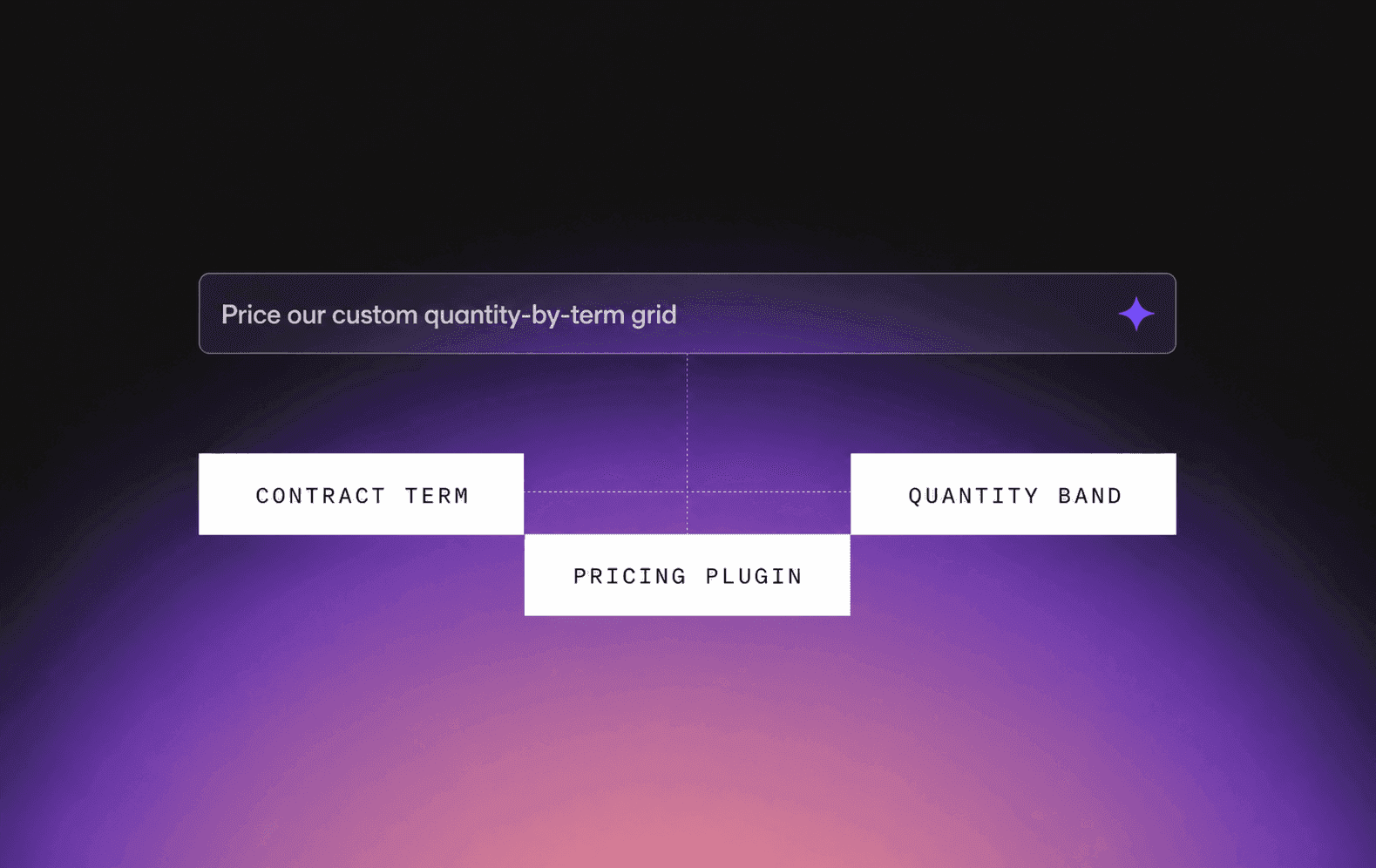
- Price a grid your configuration cannot express. For a matrix of quantity bands by contract term, a plugin finds the right cell and applies the rate automatically, replacing a fragile web of exceptions with one rule.
- Enforce margin floors without hard-blocking sales. Using custom cost and floor-price fields, a plugin holds caps and floors and warns the rep instead of freezing the quote, moving teams toward 95% of quotes handled without Finance.
- Trigger custom math off a specific product combination. A plugin watches for a defined set of SKUs landing on the same quote together and, only then, runs a calculation unique to that combination. No template rule can anticipate every pairing a sales team might negotiate.
- Coach reps in the moment, not after the fact. A plugin can catch a discount that’s too steep, a quantity that’s out of range, or a required add-on that’s missing. It will flag it right there in the quote: a heads-up for something to double-check, a stronger warning for something that needs a second look, or a hard stop only when the deal truly can’t go out as-is.
Before it writes a line of plugin code, Price Builder AI checks whether the request is already covered by a native feature — a price tag, a product relationship — and tells you so instead of building one. Plugins only get built for the logic that's genuinely one off, the last mile.
With Price Builder AI, the percentage-with-a-floor rule isn't a two-week ticket. It's a sentence you type into Nue, live before the customer refreshes their inbox, and the same rule that priced the quote holds automatically at every renewal and change order. No one has to remember it exists six months from now. And if the rule misbehaves against a real quote, Price Builder AI catches it, reproduces the failure, and rewrites itself before it ever reaches your customer, not after.
That is the shift: zero-code got pricing teams to the table; self-service last-mile customization hands them the pen.