Related tags
Your Best Expansion Signals Are Buried in Your Consumption Data
Companies using a form of Credit Burndown or Commit Burndown to manage usage-based pricing have a useful dataset hidden in their revenue stack: consumption data. A customer’s consumption data tell you how fast they’re burning through usage, how much is left in their credit balance or commitment pool, and what products they’re actually using.
To harness this data, you have to start thinking of it as more than just a Finance metric that needs to be reconciled at the end of a billing period. Consumption patterns can signal in real-time which accounts are ready to expand, which ones are at risk, and whether your pricing is working.
Here are four consumption signals you can use to drive go-to-market action, and what to do when you see them.
When a customer burns through their credit balance or commitment pool quickly, it means they’re getting value out of the product and using more than expected. It also means they could exhaust their commitment before the billing period ends.
That's the moment to open an expansion conversation, before the overage invoice does it for you. Sales or Customer Success (CS) can open up an expansion conversation so customers can top up their credits, expand their commitment, or restructure their deal to better align with their usage. The conversation is easy, because the customer already feels the need for more capacity, and you capture the upside of a larger deal.
If you aren’t paying attention to consumption data, the customer could blow past their balance and get an overage invoice they weren’t expecting. You’re left explaining the surprise charge, and the conversation starts from a place of frustration rather than momentum.
A customer tracking well below their committed spend is headed for a true-up they didn't plan for. That’s not just a billing problem, it’s an adoption failure. The product wasn’t used the way the deal intended.
Consumption data surfaces under-utilization early, while there’s still time to act.. CS can step in with mid-cycle enablement, use case coaching, or executive realignment to drive adoption while there’s still time left on the contract.
Without that visibility, the under-utilization could stay hidden until Finance flags the underspend at the end of the period. By that time, the customer has already realized the gap between what they committed to spend and what they used, and the true-up feels like a penalty. The renewal conversation then becomes an uphill battle.
When a customer buys a block of credits upfront, the revenue from the next purchase depends on how fast they burn through it. Because usage can vary wildly from month to month, Finance is left to guess when customers will come back to buy more, and how much they’ll need.
Credit burn data takes the guesswork out of that forecast. When you can see whose usage is accelerating, who stays steady, and who’s barely drawing down, you can project re-up timing and deal size with confidence — giving Finance a number to close the quarter on rather than an assumption to defend. Without burn data, credit revenue stays inherently unpredictable.
Consumption data from individual accounts tells you what to do with specific customers, but consumption data in aggregate tells you something bigger: whether your pricing and packaging are actually working the way you designed them.
If customers are over-consuming across the board, your credit packs or commitment tiers might be too small, which means you’re creating unnecessary friction when overages hit. If customers are consistently under-consuming, that could mean your packaging doesn’t match how customers actually adopt your product. And if consumption clusters around certain products or usage types, that might be a sign to restructure how you bundle products.
When you can see patterns across your entire customer base, pricing and packaging decisions can be grounded in how customers actually consume.
The consumption signals that drive expansion, flag churn risk, and sharpen your forecasting are already sitting in your billing and usage data. The difference is whether your revenue stack can reveal them at all.
The earlier you build that visibility into your revenue operations, the less you leave to guesswork.
Companies using usage-based pricing have valuable go-to-market signals hidden in their consumption data:
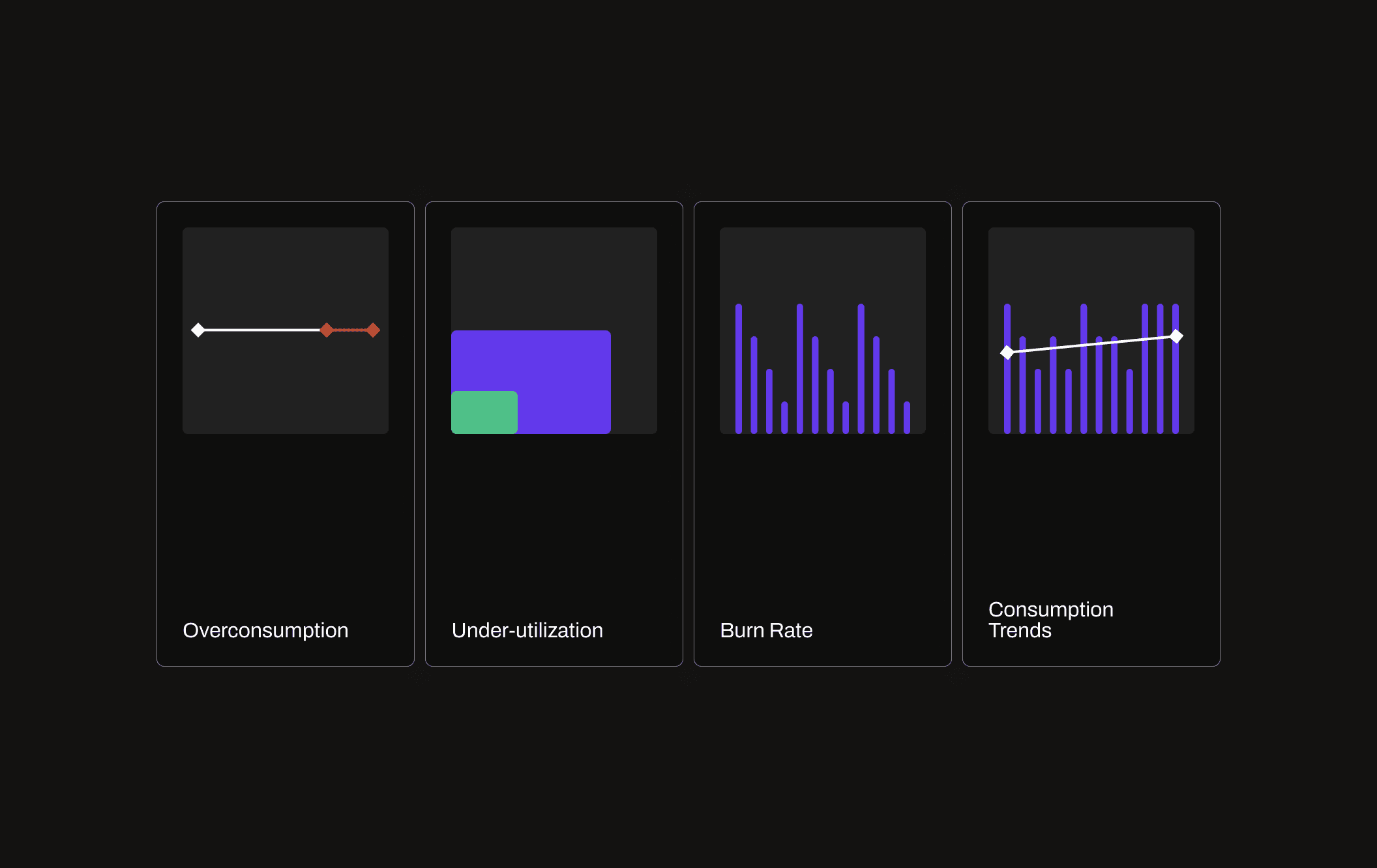
- Overconsumption can mean a customer is ready for an expansion conversation before an overage invoice surprises them
- Under-utilization is an early churn warning that gives CS time to drive adoption before the true-up hits
- Credit burn rates make revenue forecasting more predictable by showing when customers will need to re-up
- Aggregate consumption trends reveal whether your pricing and packaging actually match how customers use your product
Surface these signals early and your team can act on them before they become problems.
Learn more about Credit and Commit Burndown and how Nue helps companies manage hybrid monetization.