Credit Burndown vs. Commit Burndown: The Infrastructure Decision Behind Your Revenue Model

Related tags
Credit Burndown vs. Commit Burndown: The Infrastructure Decision Behind Your Revenue Model

Erin Rand, Content Marketing Manager


Most revenue tracking systems are built for straightforward deals. One product, predictable usage, a clean renewal cycle. That works. Right up until it doesn’t.
The moment deals get more complex — when customers start asking for subscriptions, usage, and professional services under a single agreement — that system starts to show its limits. The metering tool or homegrown spreadsheet that got you this far wasn’t built to handle this kind of complexity, and Finance is left picking up the pieces at period end.
The root cause usually isn’t the deal structure. It’s the infrastructure behind it.
That’s what credit burndown and commit burndown are built to solve. They’re not just tracking mechanisms. They’re revenue models that are built for the complexity of hybrid deals.
Here’s how to figure out which model is right for your business.
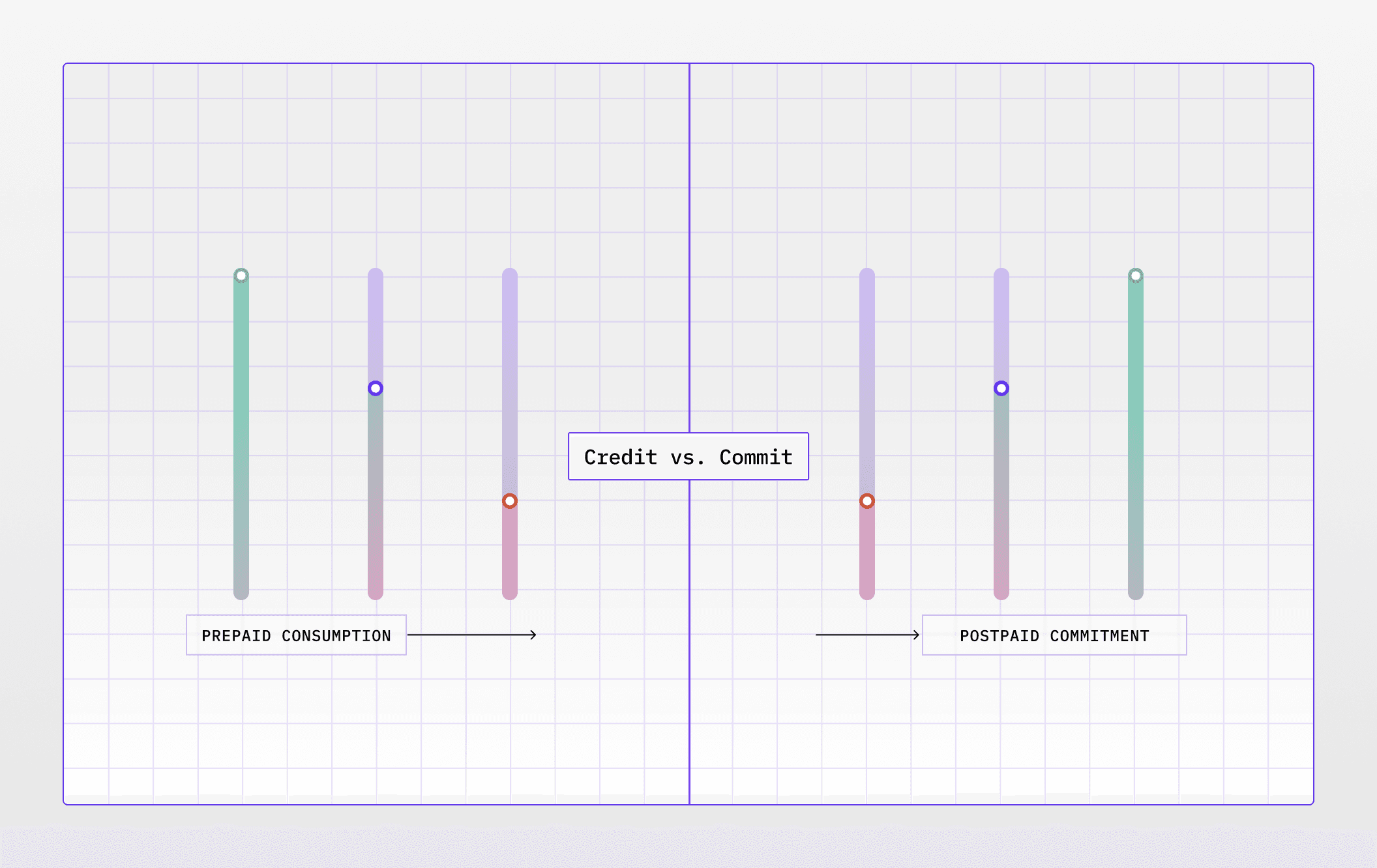
Credit burndown is a prepaid consumption model. A customer purchases a block of credits upfront and draws them down over time as they use your product. Think of it like a prepaid wallet: the balance is there, and usage pulls from it until it runs out or the credits expire. Revenue is deferred until the credits are actually consumed.
The appeal of credit burndown is its simplicity. The customer buys a block, you track the balance, and billing is relatively predictable. The challenge comes when usage gets spiky, deals get more complex, or enterprise customers want subscriptions and services folded into the same commercial agreement.
Commit burndown is a postpaid commitment model. Instead of purchasing a balance upfront, a customer agrees to a minimum spend over a defined period. Everything they purchase draws down from that single committed pool, including subscriptions, usage, professional services, and eligible credits. At the end of each period, if consumption falls short of the commitment, the customer is billed for the difference.
The key distinction from credit burndown is that the customer isn't pre-purchasing capacity. They're making a spending pledge, and the commercial structure is built around holding them to a floor while giving them flexibility in how they get there.
The easiest way to think about it: Credit Burndown starts with a balance and counts down. Commit Burndown starts with a promise and tracks against it. This chart breaks down some of the other fundamental differences:
|
Credit Burndown |
Commit Burndown |
|
|
Tracks |
Usage |
The full deal |
|
Burns |
Usage only |
Subscriptions + usage + services |
|
Anchors revenue to |
Consumption |
Committed spend |
|
How it’s billed |
Customer pays upfront and is billed in arrears on overage |
Customer is billed in arrears on committed spend |
|
Works best when |
Usage is the product |
Usage is part of a broader contract |
For many hybrid deals, credit burndown and commit burndown can also work in tandem, with prepaid credits handling variable consumption while a committed spend floor keeps revenue predictable regardless of how usage fluctuates.
The right model depends on the shape of your deals and how your customers consume. These scenarios illustrate how Nue handles each.
Tracking prepaid usage with credit burndown
Take an LLM-powered let’s business intelligence platform, as an example. A customer prepays for a $10,000 block of credits and draws them down across API calls, query executions, and data processing jobs. Each service type consumes credits at its own rate, all drawing from a single unified pool.
Nue tracks the different usage metrics and applies the corresponding credit conversions automatically, so Meridian doesn't have to manage that math manually. The commercial relationship stays contained: one balance, one customer managing their own consumption, no reconciliation surprises.
Anchoring complex deals with commit burndown
An AI services company sells to enterprise customers whose usage can be unpredictable. Rather than prepaying for a balance, a customer commits to $50,000 per quarter. Their platform subscription, API token usage, and professional services all draw down from that single committed pool.
Nue automatically reconciles those charges to track commit utilization and underspend, so if consumption falls short at period end, the true-up runs without manual intervention. The business gets a revenue floor regardless of how spiky usage gets, and the customer gets one budget and one invoice covering everything they buy.
The operational headaches that come with usage-based pricing aren't a pricing problem, but a structural one. The revenue model you choose has a lot to do with how cleanly everything downstream runs as your business scales.
Credit burndown and commit burndown aren’t interchangeable. One is built for a contained commercial relationship. The other is built for complexity. Together they determine how you track, recognize, and report on revenue across your entire customer base. Getting clear on which one fits your business — before your deals get too complex to unwind — is worth the work.
That clarity is the difference between revenue operations that scale and ones that slow you down.
Learn how to manage hybrid pricing while maintaining predictable, contract-backed revenue with our guide to Commit Burndown.