Commit Burndown: A Revenue Model Built for Hybrid Pricing

Related tags
Commit Burndown: A Revenue Model Built for Hybrid Pricing

Erin Rand, Content Marketing Manager


Hybrid pricing modes that combine subscriptions, usage, and services give customers more flexibility in how they buy and consume. But as these models become more common, they also introduce unpredictability. Consumption can swing from one period to the next, leaving sales with limited levers for structuring usage-heavy deals and finance without a reliable way to forecast or reconcile end-of-period totals. RevOps ends up stitching together usage data, discounts, and true-ups across multiple tools because there is no single place that connects consumption with the commercial terms of the deal. This fragmentation can lead to billing errors, under-billing, and revenue leakage.
To bring more predictability into these hybrid models, many companies introduce a spend commitment — an agreement where the customer promises to spend a minimum amount over a defined period. Commitments give sales clearer pricing levers and finance a stable baseline to forecast against, even when usage fluctuates.
But while the idea of a commitment is simple, managing it is not. Most teams rely on prepaid credits, custom objects, or manual reconciliation to approximate how much a customer agreed to spend and how much they’ve actually consumed. Because these systems were never designed for true committed spend, they break down quickly: commitments and consumption end up tracked in separate places, balances drift across products, and end-of-period totals must be recalculated manually. As commitment periods shift or customers add new products, the workflows become even more difficult to maintain.
To address this gap, Nue has introduced a new revenue model called Commit Burndown. It creates a structured way to anchor hybrid deals around a clear commitment while keeping consumption flexible.
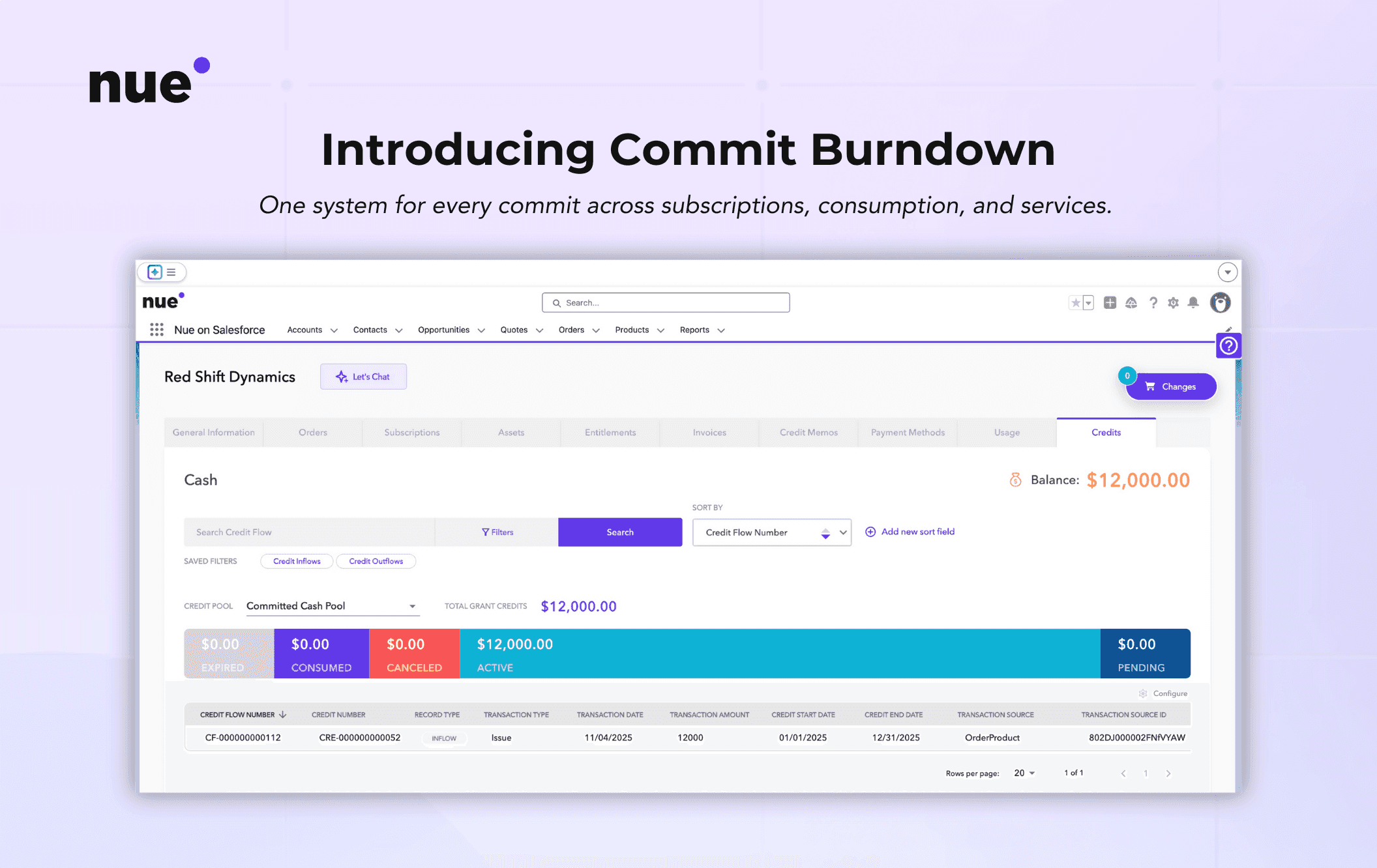
Commit Burndown is a new revenue model that lets customers commit to a set spend amount for a defined period while still consuming your product flexibly. Instead of managing commitments, usage, and true-ups in spreadsheets, Commit Burndown brings everything into one system where consumption draws down from a shared balance and end-of-period totals are handled automatically.
Here’s how it works in practice:
- Set a committed spend amount for each period. Commitments can be annual, quarterly, monthly, or aligned to the subscription term.
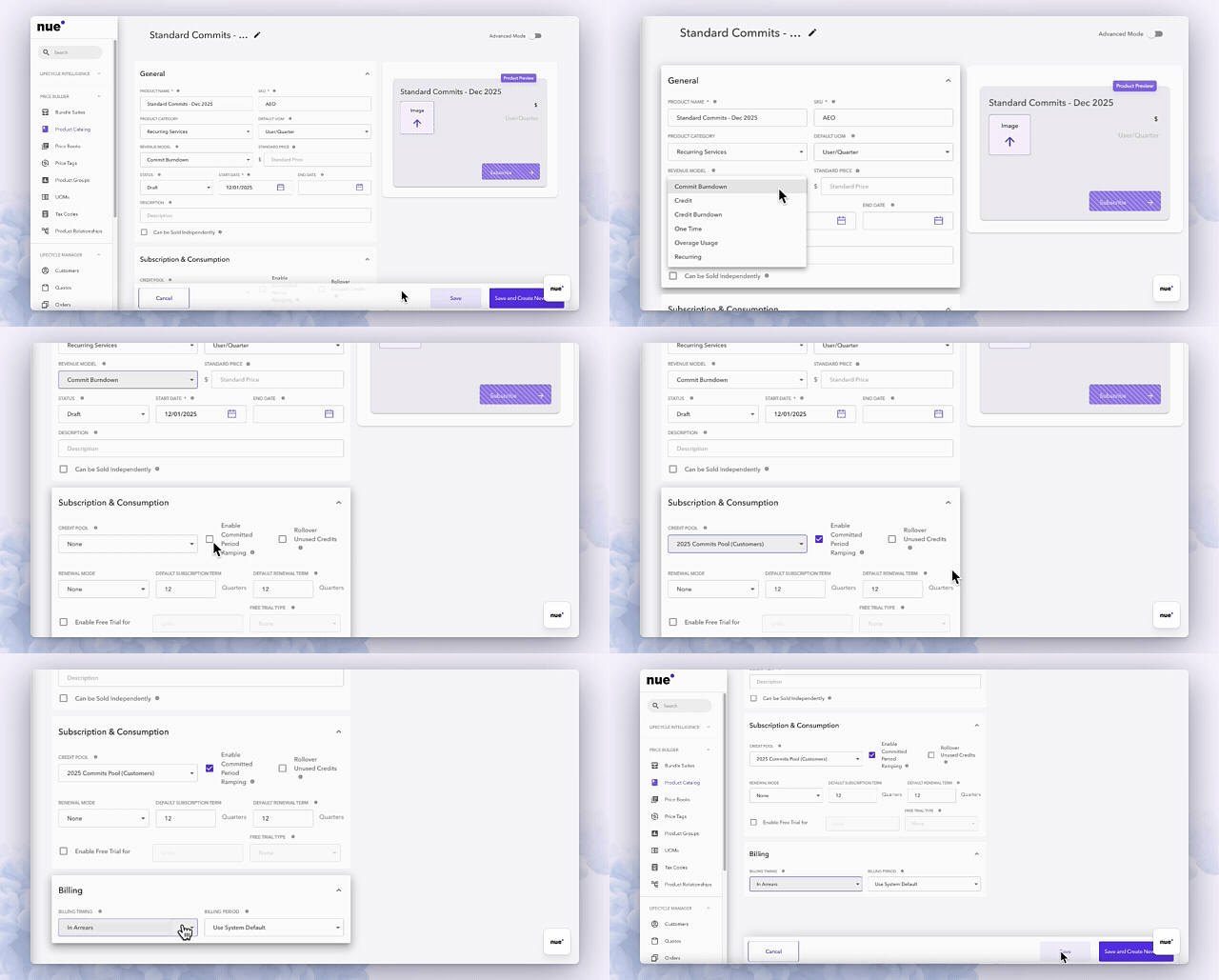
- Connect products to the committed cash pool. Usage and recurring services can burn against the same balance when configured to do so.
- Track consumption in real time. As customers use your product, Nue deducts that usage from their committed balance and keeps the remaining amount up to date.
- Manage changes safely. Commitment amounts are fixed for the current period; increases apply only to future periods.
- Reconcile at period end. Nue bills for any under-spend automatically, and unused amounts can roll over when contract terms allow.
- Keep pricing accurate as commitments change. Commit-aware pricing automatically updates tiers and discounts based on the customer’s total committed spend.
Commit Burndown provides a predictable, auditable structure for usage-heavy deals without removing the flexibility customers expect.
When commitments, consumption, and pricing all run through one workflow, complex usage-based deals become easier to manage. Here are a few common scenarios:
When customers commit annually, but their usage fluctuates
A customer signs a $2M annual commitment with an AI platform, but their monthly usage varies. As they consume services, usage burns down from the same balance. At year-end, Nue automatically bills any remaining amount and can roll unused value into the next term when allowed.
When customers want recurring and usage charges to come from one place
A SaaS vendor offers seat licenses and API usage in the same deal. Both draw from a shared committed spend pool, giving the customer one predictable budget instead of two separate bills. RevOps sees a single real-time balance for the entire contract.
When customers increase their commitment and expect better pricing
A customer decides to commit more next period. As the sales rep updates the quote, commit-aware pricing instantly recalculates the correct tier or discount, giving customers a transparent view of how higher commitments unlock better rates.
When customers need flexibility across uneven consumption periods
Some customers spread usage unevenly across quarters. With rollover enabled, unused value from one period is billed and then carried into the next automatically, making variable consumption easier to manage.
Commit Burndown brings structure, predictability, and automation to hybrid deals without taking away the flexibility customers expect. Sales gets clearer pricing levers, finance gets accurate forecasting and reconciliation, and RevOps gets one place to manage commitments and consumption together.
To see how this works inside Nue, request a demo today.