Related tags
The New Economics of Software: Pricing in the Age of AI

Mark Evans, Senior Director of Brand and Content
Pricing isn’t just about numbers anymore; it’s how modern GTM teams win.
As companies wrestle with the operational implications of generative AI, hybrid sales models, and increasingly complex customer expectations, pricing models that once felt modern now feel constraining.
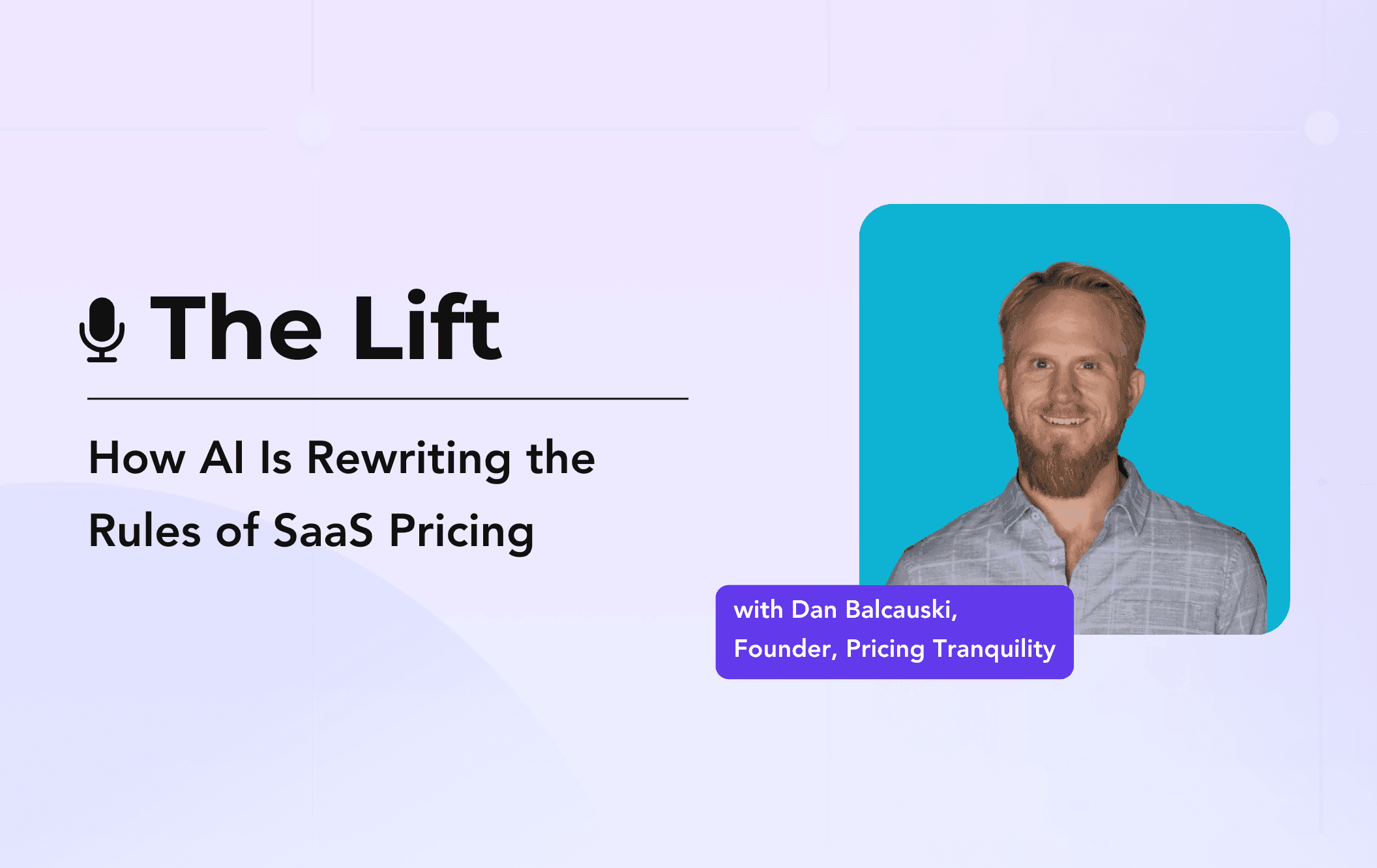
On a recent episode of The Lift, Dan Balcauski, founder of Product Tranquility and a leading SaaS pricing strategist, unpacked how AI is transforming products and redefining the very economics of software.
“It’s introducing a significant variable cost component into software, which historically operated with near-infinite contribution margins,” he noted. “Companies now have to rethink how they monetize what they build.”
Traditionally, SaaS pricing has been built around predictable, recurring revenue. But AI introduces volatility at every layer, from infrastructure costs to customer usage patterns. Costs that were once minor (like incremental compute) are now material. Features can’t be packaged into bronze, silver, and gold tiers when they’re evolving week to week.
This is forcing teams to revisit everything: how pricing is packaged, who controls it, how quickly it can change, and how it's operationalized across channels. “We’re seeing a massive shift toward experimentation,” Balcauski explained. “What used to be static packages are now constantly evolving. Companies need pricing systems that keep up with the pace of innovation.”
But experimentation isn’t just a product challenge — it’s a systems challenge. Legacy quoting and billing tools weren’t designed for the high-speed, multi-channel monetization demands of today’s market. When sales, product, and finance each operate from different tools, pricing agility becomes impossible.
Modern SaaS companies rarely rely on a single sales motion. They blend product-led growth (PLG), enterprise sales, in-app upgrades, and partner channels. This omnichannel reality requires backend infrastructure that can adapt in real time, without introducing friction.
This is where many systems break down. One tool handles subscriptions, another handles usage. Discounts are managed manually. Invoices can’t reflect changes in real time. The result? Misaligned teams, customer frustration, and lost revenue.
The common thread through Balcauski’s insights is that pricing must be treated as a living part of the GTM stack, not a spreadsheet managed in isolation. The most successful companies are embedding pricing into cross-functional decision-making and treating it as an important input to growth, not a downstream output.
“You can’t just throw pricing over the fence to Finance anymore,” he said. “In today’s environment, pricing is strategic, and it’s an essential growth lever that has to evolve as fast as the product.”
While there’s no one-size-fits-all model, one thing is clear: SaaS businesses that can’t support real-time experimentation across sales motions, pricing models, and customer lifecycles will find themselves locked out of the next wave of growth.
AI isn't just changing what software does. It's changing the economics behind how it's built, sold, and priced, and most GTM teams aren't set up for that shift yet.
- AI introduces real variable costs into a business model that historically ran on near-infinite contribution margins. That alone forces a fundamental rethink of how pricing is structured and who owns it.
- Modern SaaS companies blend PLG, enterprise sales, in-app upgrades, and partner channels. When backend systems can't keep up with that omnichannel reality, pricing agility becomes impossible and revenue leaks through the gaps.
- The companies winning right now treat pricing as a living part of the GTM stack, not a downstream output managed in isolation by Finance.
Pricing is no longer a function. It's an infrastructure choice, and it determines how fast you can grow.
Listen to the full conversation with Dan Balcauski on “The Lift,” part of our Pace of Change series.