Usage bills at the terms that closed the deal.
AI changed what companies sell, and consumption now drives revenue. Nue Metering connects it to the quote, so there is one copy of the deal from signature to invoice.
What is metering
Metering turns every unit of use into a line on the bill
It works like the meter on a house. It records use as it happens, and the reading becomes a bill.
Software is shifting from paying per seat to paying per use. AI breaks the per-seat model, because two people on the same plan can create very different amounts of work.
Electricity
Kilowatt-hours → monthly bill
AI software
Tokens, calls, compute → usage bill
One person, one license, one flat fee
Per use
Pay for the work the product actually does
How metering works
Every usage event takes four steps to become revenue
Rating is the step that has to know the deal. It only works if the price in the meter matches the price in the contract.
- 1
Capture
Record every event the moment it happens
- 2
Measure
Group events into time windows and measure them by sum, count, max, min or average
- 3
Rate
Apply the agreed price to what was measured
Where the deal has to be known
- 4
Bill
Add it to an invoice or draw down a prepaid balance
The problem
Most stacks rate usage against a second copy of the deal
Usage gets captured in one place and priced in another, so ramps, tier thresholds, discounts, commits and credits get re-created downstream. That second copy is where drift starts.
Copy one · the signed quote
- Year 1 rate
- $1.00 per 1K calls
- Year 2 ramp
- $0.80 per 1K calls
- Volume tier above 10M calls
- 15% off
Copy two · the metering tool
- Year 1 rate
- $1.00 per 1K calls
- Year 2 ramp
- $1.00 per 1K calls
- Volume tier above 10M calls
- 15% off
The ramp never made it downstream. Every call in year 2 bills 25% high until someone reconciles.
When the deal exists twice, every team pays for the gap
RevOps and billing
Every change becomes a sync job
Upgrades, renewals and amendments get pushed into a second system and checked by hand.
Finance
Revenue leaks quietly
Drift surfaces at reconciliation, after the invoice has already gone out.
Pricing
Packaging waits on engineering
Every new tier or model is a ticket before it can bill, so launches slip.
What if the deal only existed once?
One engine
Nue meters, rates and bills on the engine that priced the quote
There is one copy of the deal. Not two systems trying to agree.
Most stacks today
QuoteMetering toolBilling
Three systems, two copies of the terms, and a reconciliation step between each.
With Nue
QuoteNueQuote · meter · rate · billInvoice
One engine holds the contract, so the meter always prices with the terms Sales closed.
Rated against the contract
Every usage event rates against the terms that closed the deal
When a deal closes in Nue, the commercial terms that were actually agreed to are locked in.
Effective date
Usage before the effective date
Rated at the original terms
Usage after the effective date
Rated at the amended terms
Amendments split usage at the effective date.
- Consumed
- Remaining
- Overage
<10 sec
from a usage event to an updated credit balance
Real-time credits
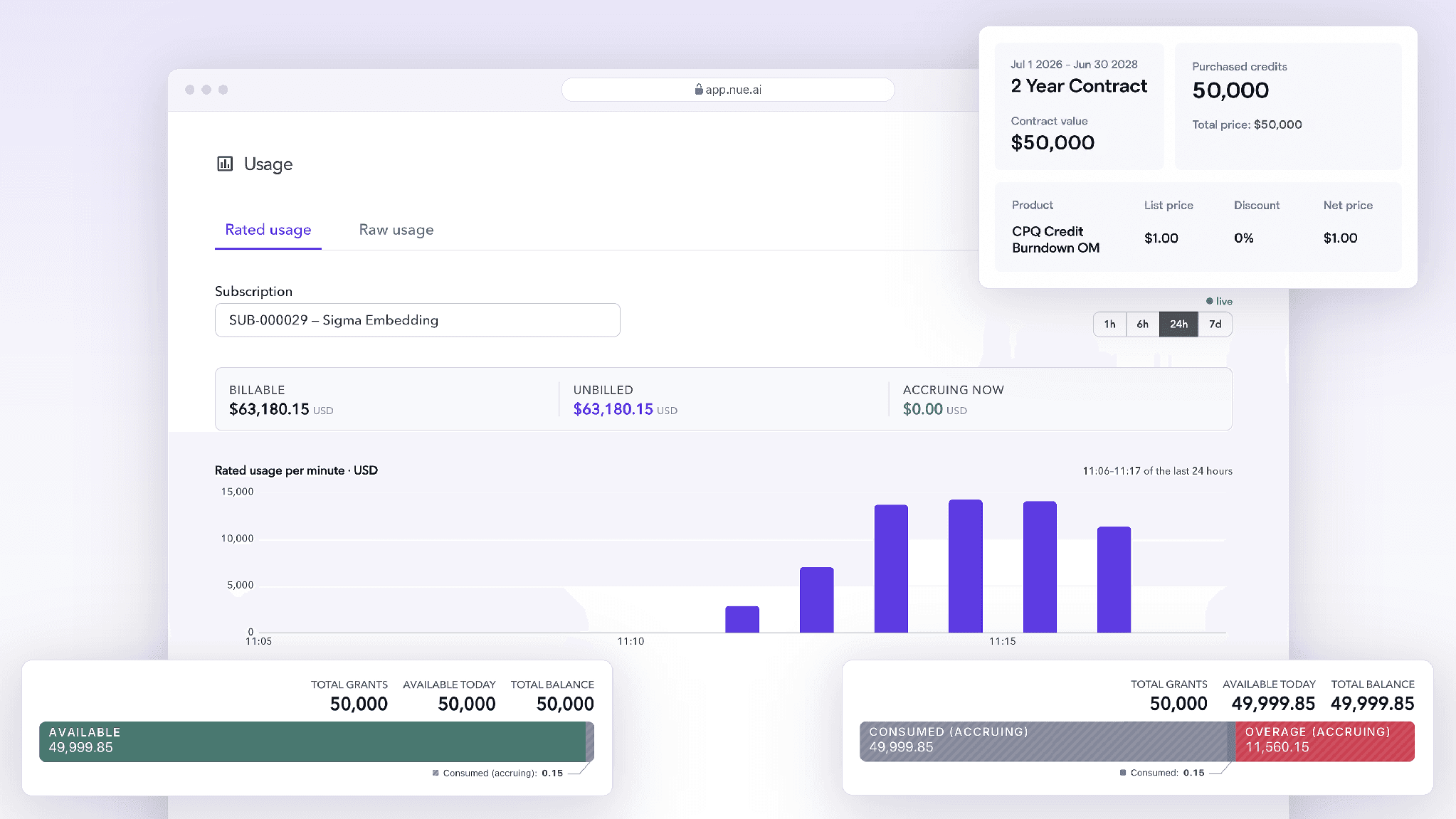
Credit balances update in under ten seconds, not at month end
Most teams learn a customer ran out of credits when the invoice arrives. By then the moment has passed.
With Nue, overage is visible the moment it starts, not at month end.
One contract
Usage, seats, services, credits and commits share one contract
Usage doesn’t have to live in its own silo.
One contract
- Usageper token, per call
- Seat subscriptionsper seat, per month
- Professional servicesone-time
Shared credits and commits
- Usage burns against the same credits or commitsThe same balance covers usage and the rest of the contract.
- Subscription and consumption models evolve togetherAdding a usage component is a contract change, not a new system.
- No separate version of the deal to meterMetering reads the same contract Sales closed.
Built to rate usage at high volume
Scale is part of the architecture, not a tradeoff against getting the contract right.
25.9B+
usage events processed each month
10K+
usage events processed per second, per business
Outcomes
One copy of the deal pays off for every team that touches revenue
Each outcome removes a cost that existed only because the deal lived in two systems.
RevOps and billing
Faster, cleaner close
Usage bills correctly with no second system to set up or sync
Finance
Less revenue leakage
Rated usage, credit balances, overage and invoice lines match what was sold
Pricing
Faster time to market
New tiers and models go live without an engineering ticket
Account teams
Expansion conversations earlier
Live balances show which customers are running low or tipping into overage
FAQ
Questions buyers ask about Nue Metering
Do we have to replace our CPQ?
- No. Metering runs on the Nue pricing engine, so an account on another CPQ can adopt metering now and move quoting later.
Can Nue handle our volume?
- Up to 10,000 events per second. Size against peak usage, not the monthly total.
What about late usage?
- It bills at the terms in force when it happened, well past the 33-day window most metering tools allow.
Can third-party usage like AWS come in?
- Yes. It lands against the same customer and the same invoice as the usage Nue meters directly.
Nue Metering